
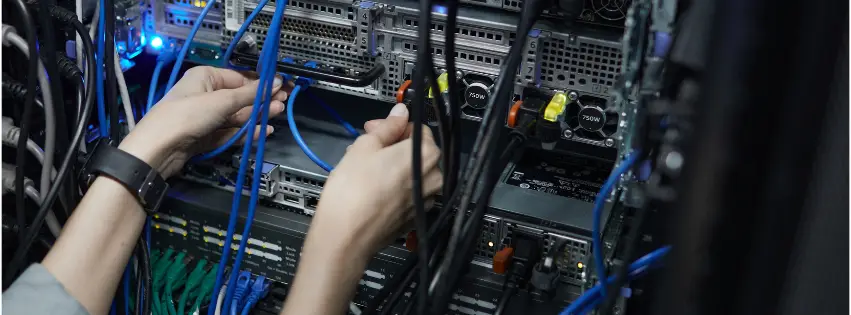
Fiber optic cabling gets specified in Brevard County facilities for reasons that rarely come up in a bandwidth conversation. Copper Ethernet stops working past 100 meters. Fiber carries light instead of current, so a variable frequency drive running twenty feet away does nothing to it. And on the Space Coast, everything metal around that fiber has to survive salt air. Speed is usually the last item on the list, not the first.
Copper stops at 100 meters, and that is usually the entire decision
Balanced twisted-pair cable — Cat5e, Cat6A copper cabling, it does not matter which — is specified to a 100-meter channel. That is 90 meters of permanent horizontal cable plus about 10 meters of patch cords at the two ends. Go past it and the link either fails certification outright or, worse, works well enough to pass traffic and then drops packets under load two years later while three people argue about whether it is the switch.
A 200,000-square-foot assembly building in Palm Bay is longer than 100 meters corner to corner. So is the run from a main equipment room in one Titusville building to a test bay in the building next door. Copper can be extended by building an intermediate telecom room partway across the site, but that means another conditioned space, another circuit, another cooling load, and another rack of electronics somebody has to maintain. Fiber removes the reason to build it.
Single-mode vs multi-modeThe choice is about distance and optics cost, not about the glass
Multi-mode (OM3, OM4, OM5)
Multi-mode fiber has a large core, typically 50 microns, and light travels down it along several paths at once. That larger target is what allows cheap 850 nm transceivers to work, and the cheap transceivers are the entire point of multi-mode. OM3 carries 10 Gb to roughly 300 meters and OM4 to roughly 400 meters. Push the same fiber to 40 or 100 Gb and those distances drop to about 100 and 150 meters. OM5 is wideband multi-mode built for short-wavelength division multiplexing, which earns its keep in dense data center rows and almost never decides anything in a plant.
Single-mode (OS2)
Single-mode fiber has a 9-micron core and one light path. At the scale of any facility in Brevard County, distance stops being a constraint — standard optics reach 10 kilometers, and nobody has a campus that long. The cable itself is not the expensive part. Single-mode often costs less per foot than OM4. The transceivers on each end cost more, and that is the real trade you are making.
So the useful question is not which fiber is better. It is how long the run is and how many years you want to go before anyone touches it again. Under 300 meters, inside one building, with 10 Gb as a realistic ceiling for the next decade, OM4 wins on total installed cost. Building-to-building, across a campus, or anywhere you want a 25-year horizon, single-mode wins and it is not close. Plenty of Space Coast campuses end up running both: single-mode between buildings, OM4 for in-building risers.
| Media | Practical distance | Cost per drop (2026) | Best use case | EMI immunity |
|---|---|---|---|---|
| Single-mode (OS2) | 10 km on standard optics; effectively unlimited at facility scale | $350–$900 | Building-to-building and campus backbone; any link with a 20–25 year horizon | Complete |
| Multi-mode (OM4) | ~400 m at 10 Gb; ~150 m at 40/100 Gb | $300–$700 | In-building backbone risers, plant floor runs, shorter campus links | Complete |
| Cat6A copper | 100 m channel, hard limit | $175–$500 | Horizontal drops to workstations, cameras, access points, PoE devices | Limited; shielding and separation required near noise sources |
What actually drives fiber into Space Coast plants
The buildings pulling fiber in this county are not offices. They are aerospace and defense supplier plants in Melbourne and Palm Bay, test and integration buildings near Cape Canaveral and Merritt Island, and large-footprint manufacturing in Titusville, Rockledge and Viera — the kind of sites that need a purpose-built structured cabling system in Brevard County, not an off-the-shelf office network. The reasons stack up in a specific order.
- 1The run is longer than 100 metersThe most common reason and the least interesting one. Once the distance is there, the conversation is over — copper is not an option and the only remaining question is which fiber.
- 2Electrical noise on the floorFiber carries no electrical signal, so motors, variable frequency drives, welders, induction heaters and RF test equipment have nothing to couple into. In a machining bay or an EMC test area this is frequently the actual reason fiber gets specified, and bandwidth is just the justification written on the requisition.
- 3No electrical path between buildingsTwo buildings on separate services sit at slightly different ground potentials. A copper link between them is a conductor bridging that difference, which is how ground loops, hum, and destroyed switch ports happen. All-dielectric fiber creates no such path.
- 4Lightning exposureBrevard County sits in one of the most lightning-dense corridors in the United States. A dielectric fiber cable with no metallic strength member or armor gives a strike or induced surge nothing to travel on between structures.
- 5The glass outlives the electronicsOptics get faster every few years. Installed single-mode fiber does not need to change when they do. Upgrading a backbone becomes a transceiver swap in two equipment rooms instead of a pull through occupied space.
The glass does not corrode. The metal around it does. Connector ferrule hardware, splice tray screws, rack and ladder hardware, enclosure hinges, latches and grounding points all sit in salt-laden air at facilities on Merritt Island, in Cape Canaveral, and anywhere near the Indian and Banana rivers. An installation that would last 25 years in Ocala can show green corrosion on terminations in a few seasons here if the enclosures are not sealed or gasketed and the hardware is not specified for a marine environment.
Practical consequences: keep terminations and splice points inside conditioned space wherever the design allows, use sealed enclosures at any outdoor or unconditioned transition, and specify corrosion-resistant hardware rather than accepting whatever ships in the box. This costs very little at install and is expensive to correct later.
Aerial versus underground is a hurricane decision
Aerial pathway is cheaper to install and faster to repair. It is also the first thing to come down in a named storm, and the first thing a falling limb takes out in an ordinary afternoon thunderstorm. Underground in conduit or duct bank costs more up front and is essentially immune to wind; the risk shifts to water intrusion at handholes and to whether anyone documented where the duct actually runs before the person who installed it retired.
For a facility that has to be operational the week after a storm — and on the Space Coast that describes most defense and aerospace suppliers — underground between buildings is usually worth the premium. Where aerial is the only realistic option, self-supporting all-dielectric cable and generous slack storage at each pole make the repair fast when it does come down.
CostWhat a fiber drop actually costs in 2026
Installed and terminated, OM4 multi-mode runs $300 to $700 per drop in this market. Single-mode runs $350 to $900. For comparison, Cat6 copper runs $125 to $400 per drop and Cat6A $175 to $500. Fiber is more expensive per drop, but the comparison is rarely apples to apples, because the runs where fiber gets used are runs copper cannot make at all.
The spread inside each range is almost entirely pathway. An open ceiling over a warehouse floor with cable tray already installed is fast work. Core drilling a slab, fishing finished drywall in an office area attached to the plant, or pulling 400 feet of innerduct between two buildings is not. When a quote comes in at the bottom of the range, ask what pathway the contractor assumed. Unstated pathway assumptions are where change orders are born.
Testing and certification adds roughly 5 percent to the project. It also unlocks 20 to 25 year manufacturer warranties on the installed cabling system, which makes it the best-value line item on most quotes.
TestingCertified test results, not “it lights up”
Two tests matter, and they answer different questions. Insertion loss testing, done with a light source and power meter, measures how much light arrives at the far end and compares it against the calculated loss budget for that specific link — length, splices, connector pairs. That is the pass or fail. OTDR testing sends a pulse down the strand and maps where loss occurs along it: a poor splice at 180 feet, a bend radius violation behind a rack, a contaminated connector. Insertion loss tells you the link passes. OTDR tells you why it does, or why it does not.
A fiber link nobody tested is not an asset on the drawing. It is an assumption, and it fails on the day the plant is busiest.
Results should be delivered per strand, in a documented report, referenced to the TIA/EIA standard the link was tested against. Keep that file somewhere better than the project manager’s inbox. When a link starts degrading in year six, the day-one trace is what turns a two-day hunt into a two-hour repair, because you can compare the new trace against the original and see exactly what changed. Manufacturer warranty programs require the same documentation — no certified test results, no warranty.
QuestionsCommon questions about fiber in Brevard County facilities
How far can fiber optic cable run compared to copper?
Copper Ethernet is limited to a 100-meter channel: 90 meters of horizontal cable plus roughly 10 meters of patch cords. OM3 multi-mode carries 10 Gb to about 300 meters and OM4 to about 400 meters. Single-mode reaches 10 kilometers on standard optics, so at building or campus scale distance stops being a design constraint at all.
Should a campus fiber backbone be single-mode or multi-mode?
Single-mode for anything that leaves a building, crosses a campus, or needs to stay in service 20 years or more. Multi-mode OM4 for in-building backbone risers and shorter runs, where the cheaper 850 nm optics on each end bring the total down. Many Brevard County campuses run both: single-mode between buildings, OM4 inside them.
Is fiber worth installing if we are not short on bandwidth?
In a plant or test facility, often yes. Fiber carries light rather than current, so it is immune to interference from motors, variable frequency drives, welders and RF test equipment, and it creates no electrical connection between buildings that could carry a ground potential difference. Those two properties, not throughput, are usually why fiber gets specified on a manufacturing floor.
What does fiber optic cabling cost per drop in Brevard County?
In 2026, OM4 multi-mode runs roughly $300 to $700 per drop installed and terminated, and single-mode runs roughly $350 to $900. Cat6 copper runs $125 to $400 and Cat6A $175 to $500. Pathway difficulty drives most of the spread inside each range, and testing and certification adds about 5 percent.
Does the coastal environment affect a fiber installation?
Yes, though not the glass itself. Salt air attacks the metal around the fiber: connector hardware, splice trays, rack hardware, enclosure hinges and latches, and grounding points. Facilities near Cape Canaveral, Merritt Island and the barrier islands need sealed or gasketed enclosures, corrosion-resistant hardware, and pathway choices that keep terminations out of unconditioned salt-laden air.
Planning a fiber backbone in Brevard County?
BBTS has been designing and installing structured cabling on the Space Coast since 1982, including cabling work at NASA and Kennedy Space Center facilities and projects for aerospace contractors. We will walk the building, measure the actual runs, and tell you where single-mode is worth the optics and where OM4 is the smarter spend.
5125 S. U.S. 1, Suite 1, Rockledge, FL 32955 · Serving Melbourne, Palm Bay, Titusville, Viera, Merritt Island and Cape Canaveral
About BBTS Solutions. Brevard Business Telephone Systems, Inc. has served Brevard County since 1982 as a Florida-licensed Low Voltage Contractor. Our team includes an RCDD-certified designer, we are a BICSI member, and all fiber and copper installations are tested and certified to TIA/EIA standards with documented results delivered to the customer. We have completed cabling and low-voltage work at NASA and Kennedy Space Center facilities and for aerospace contractors on the Space Coast.